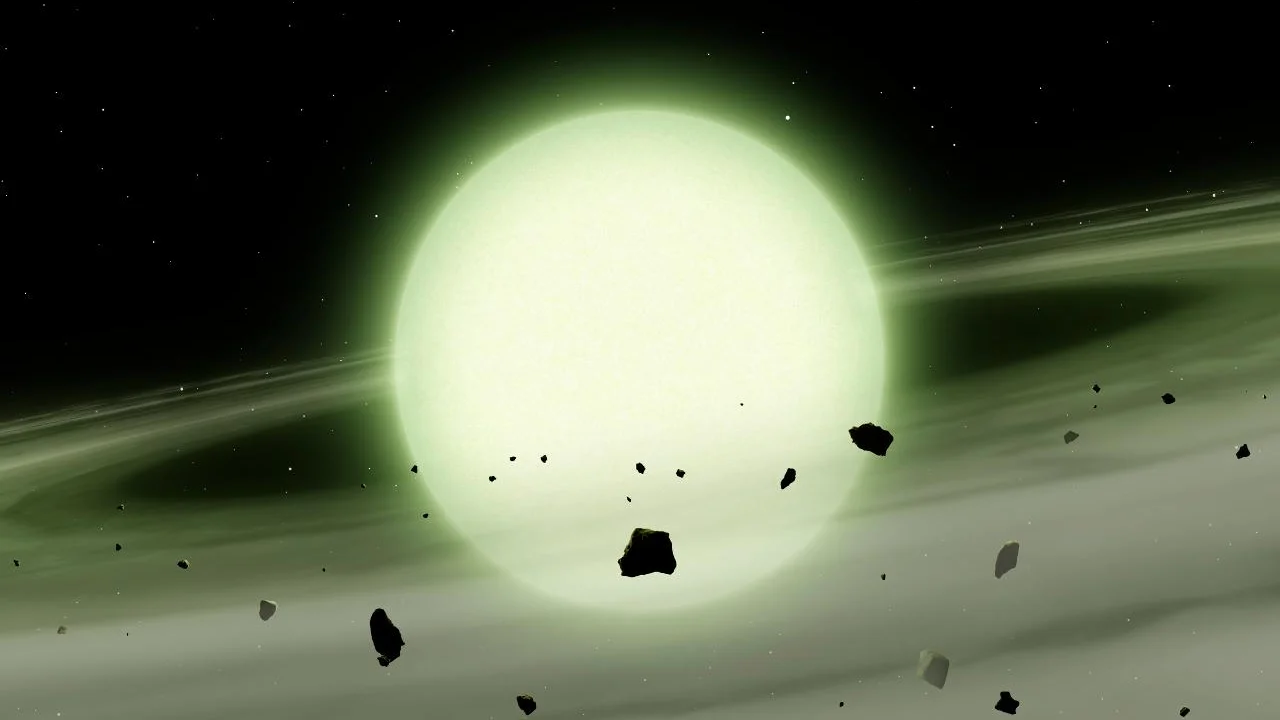

A University of Warwick team says white dwarf WD J1330+6435 would glow green to the eye, the first green star known. Others would look pink, purple or yellow.
Astronomers at the University of Warwick have found what they believe is the first genuinely green star known in the Galaxy. It is a white dwarf called WD J1330+6435, and in the team’s models it would glow a chartreuse green to the human eye.
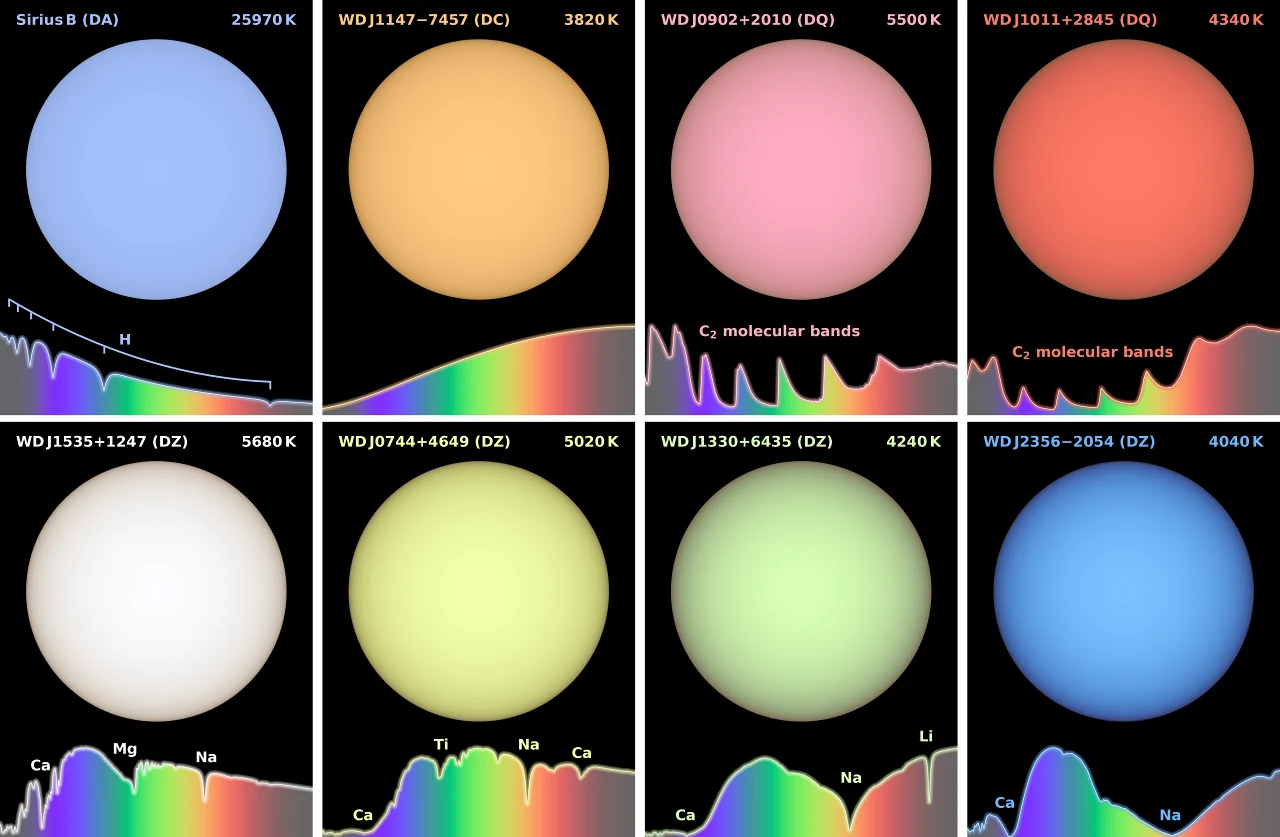
The finding is part of a wider study showing that white dwarfs, the dense remains of Sun-like stars, can appear green, pink, cyan, yellow and purple. The university announced the research on 15 October. The paper is published in the journal RAS Techniques and Instruments.
The work was led by Dr Mark Hollands, a Warwick Prize Fellow in the university’s Astronomy and Astrophysics Group. The campus is on the southern edge of Coventry, about six miles north of Leamington.
“It turns out these incredibly dense stars can produce colours nobody expected, and some of them genuinely surprised me,” he said.
Why most stars are orange, white or blue
For most stars, colour follows temperature. Cooler stars look orange, stars like the Sun look white and the hottest look pale blue. White dwarfs were thought to follow the same rule.
The Warwick team found that density breaks it. The coolest white dwarf atmospheres can reach around 1 gram per cubic centimetre, roughly the density of water and millions of times denser than the Sun’s visible surface, the university said. At that density, trace elements such as carbon, calcium and sodium absorb light across a wider range of colours than usual.
No white dwarf is close enough to see its colour directly. The team worked it out from each star’s spectrum, the pattern of light split by wavelength, and ran it through a model of human colour vision.
Which stars come out which colour
According to the university, the colours fall into groups linked to what is in each star’s atmosphere:
- Pink or purple: white dwarfs rich in carbon
- Yellow: those enriched with debris from shattered asteroids and comets
- Cyan or pale blue: cooler ones with mixed hydrogen and helium atmospheres
- Green: WD J1330+6435, at roughly 4,000C, whose atmosphere carries calcium, lithium and sodium from rocky material it has pulled in
“The traces of sodium in the atmosphere of this white dwarf absorb the orange part of the spectrum, leaving behind a ghostly green glow,” Dr Hollands said. “Imagine standing on a planet and looking up at a green star.”
The team also identified what may be the reddest star ever recorded. WD J1011+2845, 48 light years from Earth, has carbon lifted from its core to its surface, which gives it a deep salmon-pink glow.
Most white dwarfs really are white
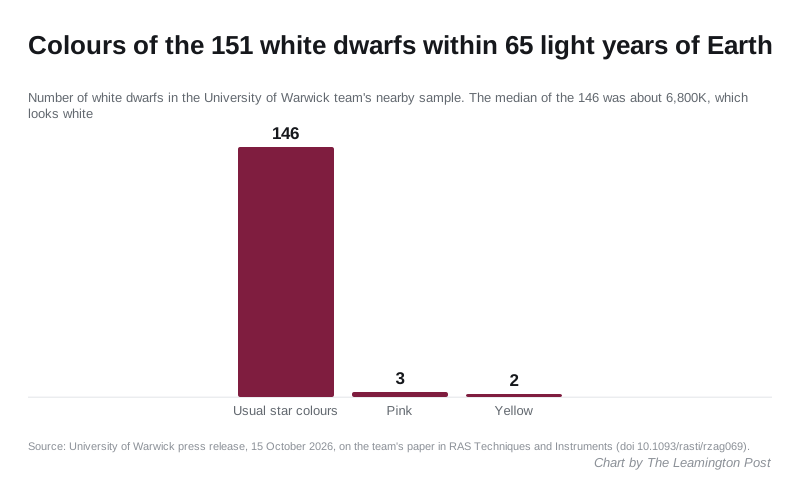
The team also looked at a representative sample: the 151 white dwarfs within 20 parsecs, about 65 light years, of Earth. Five had unusual colours, two yellow and three pink. That suggests about one in thirty white dwarfs in the Universe shines an unusual colour, the university said.
The median colour temperature of the other 146 was about 6,800 Kelvin, which the eye sees as white. For comparison, a “warm white” light bulb is about 3,000K and a “cool white” one about 6,000K.
That corrects a common belief that white dwarfs are typically blue. Hotter, bluer ones are brighter and visible from further away, so surveys that rely on brightness over-count them.
“Across the entire population of white dwarfs in the Universe, that is still a lot of oddly coloured stars out there,” said Professor Boris Gänsicke of the university’s Department of Physics. “Yet if we take the median across a representative population of white dwarfs, we found that the average white dwarf really is white.”
What it means for you
None of these stars can be seen in colour from a back garden in Leamington or Warwick: they are too faint and too far away, and the colours come from the team’s calculations. But the method needs only a star’s spectrum, data astronomers already collect routinely. So the same check can now be run on any white dwarf that has been measured.
The paper, “Any colour you like: The diverse chromaticities of white dwarfs”, is free to read on the journal’s site.
Have your say