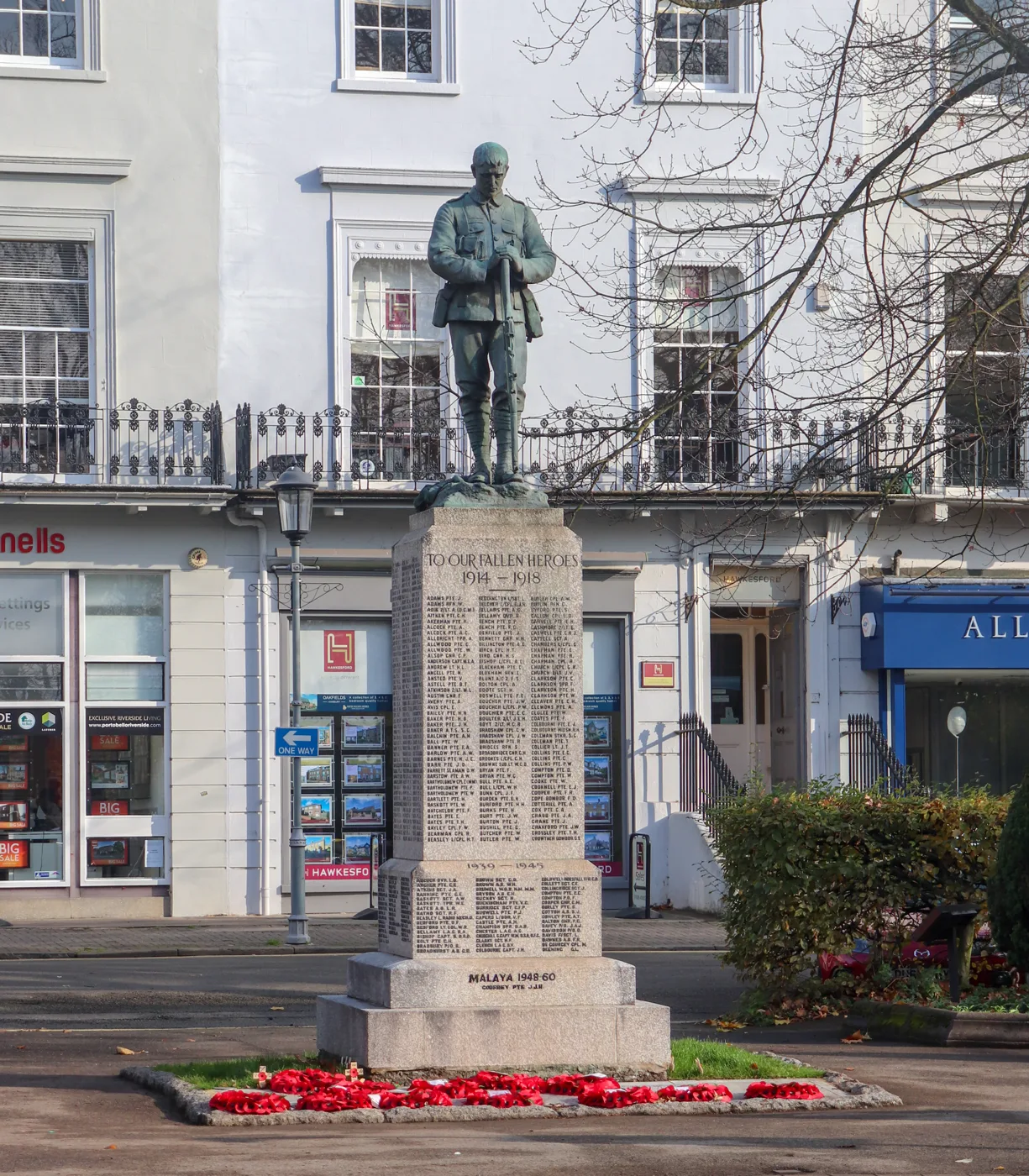

Leamington History Group is researching every Second World War name on the town's war memorial. Four stories are online, and more are being written.
Volunteers are working to tell the story of every Second World War casualty named on Leamington’s war memorial. The project, called Behind the Names, is run by Leamington History Group. Its first four stories are online, just ahead of Remembrance Sunday on 8 November.
The four so far are Reginald Frank Batho, Stanley James Cotton, Charles Septimus Aliband Graves and Hugh Michael Lilley. They show how many different roads led from this town to the same list of names.
The shop worker on a sunken destroyer
Stanley Cotton was born in Leamington in 1919, and his parents lived at 6 Windsor Place. He went to Milverton School and worked for Barnes fruit stores and Cecil Mason Ironmongers before joining the Royal Navy in 1936.
He married at St Peter’s Church in April 1940. Five months later, on 1 September, he died when HMS Esk was sunk in the North Sea. The destroyer had been converted to lay mines and hit one off the coast of Holland.
His family appears on the memorial twice. His mother’s first husband, Sidney Smith, was killed in action in 1917 and is named in the First World War section.
The artist’s son in Burma
Hugh Lilley was born in Leamington on 2 March 1915. His father was an artist who exhibited at the Royal Academy and came to the town as Art Master at Leamington Technical College.
At 19, Hugh sailed to Burma as a police probationer. In 1940 he became an officer in the 7th (Burma Police) Battalion of the Burma Rifles. He died on 1 February 1942, aged 26.
The group’s researchers point to a Japanese attack on Moulmein that began two days earlier. The battalion reported one British officer missing, believed killed. Given the date, they say, that was probably Hugh. He is commemorated on the Rangoon Memorial in Myanmar.
The clerk who jammed enemy radio
Charles Graves grew up at 10 Willes Terrace and went to Leamington College for Boys. He worked as a cost clerk at the Lea-Francis car company in Coventry and drove an ambulance for Air Raid Precautions.
In the RAF Volunteer Reserve he joined 101 Squadron, Bomber Command, as a special duty operator. The job was to listen for German night-fighter controllers and jam their transmissions, working alone behind a curtain in a dark, cold and cramped space.
He was killed on an operation to Les Hayons in France on 24 June 1944, aged 30. He is buried at St James Churchyard in Southam, about seven miles south-east of Leamington.
What it means for you
- Read the stories: they are all linked from the group’s project page.
- Add what you know: the group asks anyone with information, or who would like to help with the research, to email chair@leamingtonhistory.co.uk.
- Remember the civilians: the group is holding a short service for the town’s Second World War civilian dead at the war memorial on Tuesday 10 November, from 10.45am to 11.15am.
- Sunday’s service: our Remembrance Sunday page has the times and every road closure.
Have your say